
Nutrition and Bioavailability: Why the Body Doesn’t Use Everything We Eat
How protein quality, food tolerance, and nutrient density affect the nervous system’s ability to repair, regulate, and rebuild

This is Part 3 of 4 in a series exploring how nutrition and the nervous system affect each other.
In the first article of this nutrition series, we looked at why nutrition matters for nervous system regulation. In the second article, we looked more closely at digestion: stomach acid, bile, enzymes, minerals, gut support, anti-nutrients, food preparation, and the way cooking changes what the body can receive.
In this article, we are continuing that conversation by looking more closely at bioavailability. Bioavailability simply means how much of a nutrient the body can actually absorb, access, and use. In other words, are the foods we choose actually giving the body enough of what it needs to repair, regulate, and rebuild?
Many people try to eat well and still feel like their body is not getting stronger. They may be eating whole foods, avoiding processed foods, adding vegetables, choosing “healthy” options, and still feeling depleted, reactive, tired, inflamed, or hard to nourish. That can be confusing, because on paper, the diet may look healthy. But the deeper question is whether those foods are giving the body enough usable nourishment to repair, regulate, and rebuild.
This is not about judging people’s food choices. It is about understanding why a diet can look healthy and still leave the body without enough of what it needs.
This is where nutrition labels, diet identities, and wellness rules can become misleading. A food can look complete on paper and still provide less usable nourishment than people assume. A diet can look clean, disciplined, or nutrient-dense and still fail to give the body enough building materials. And a body can compensate for a long time before the cost becomes obvious.
That is what this article is about: usable nourishment.
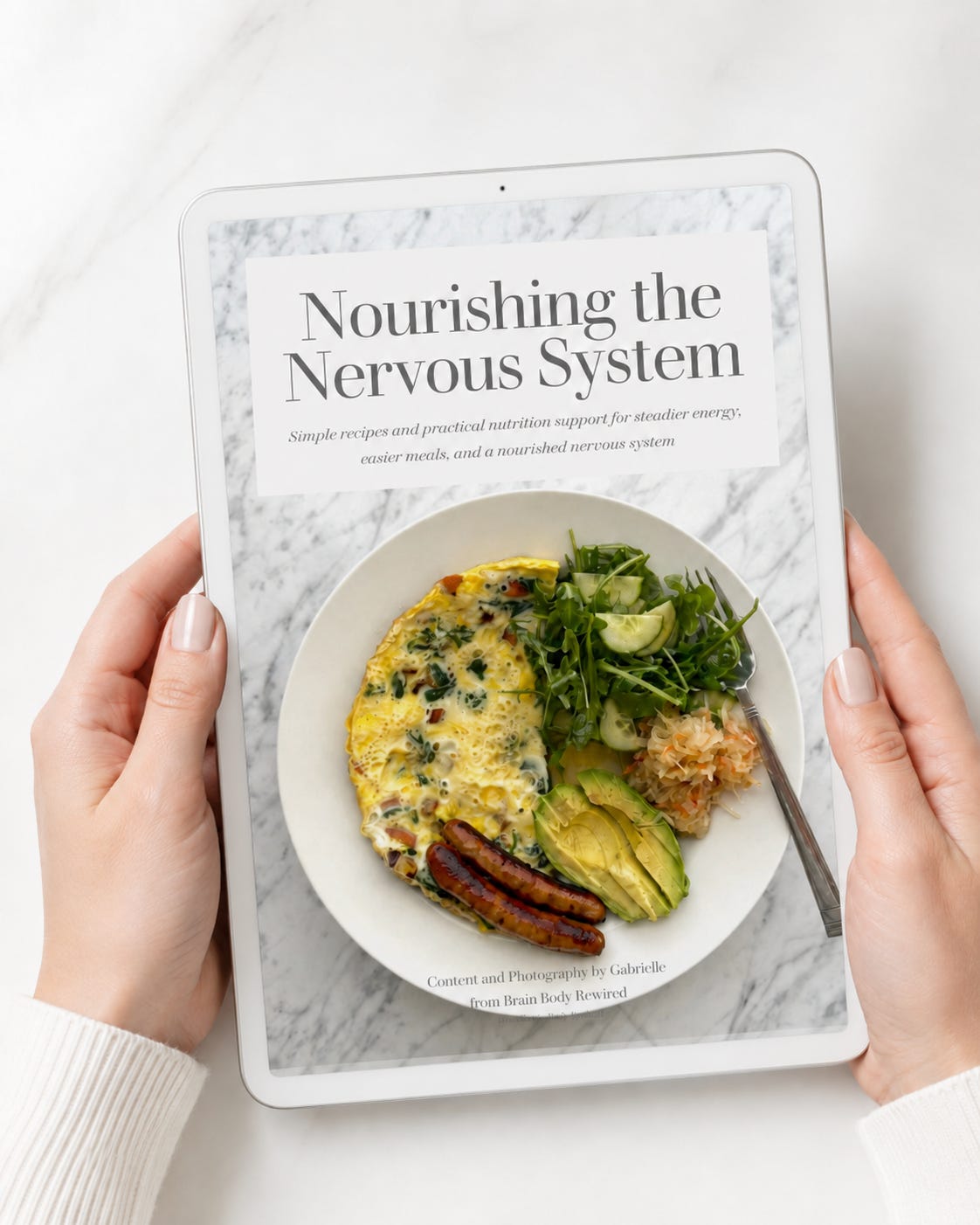
Before we go deeper, I want to say a heartfelt thank you to everyone who has already purchased my new cookbook-guide, Nourishing the Nervous System. Your support means so much. If you haven’t purchased a copy yet, it’s a practical companion to this series, with simple recipes that I use personally, gentle nutrition tips, and flexible meal ideas for bringing steadier nourishment into everyday life.
If you haven’t had a chance to read Part 1 and Part 2 of this series yet, I highly recommend starting there. They’ll give you the foundation for what we’re going to explore here.


Complete on paper does not always mean complete in the body
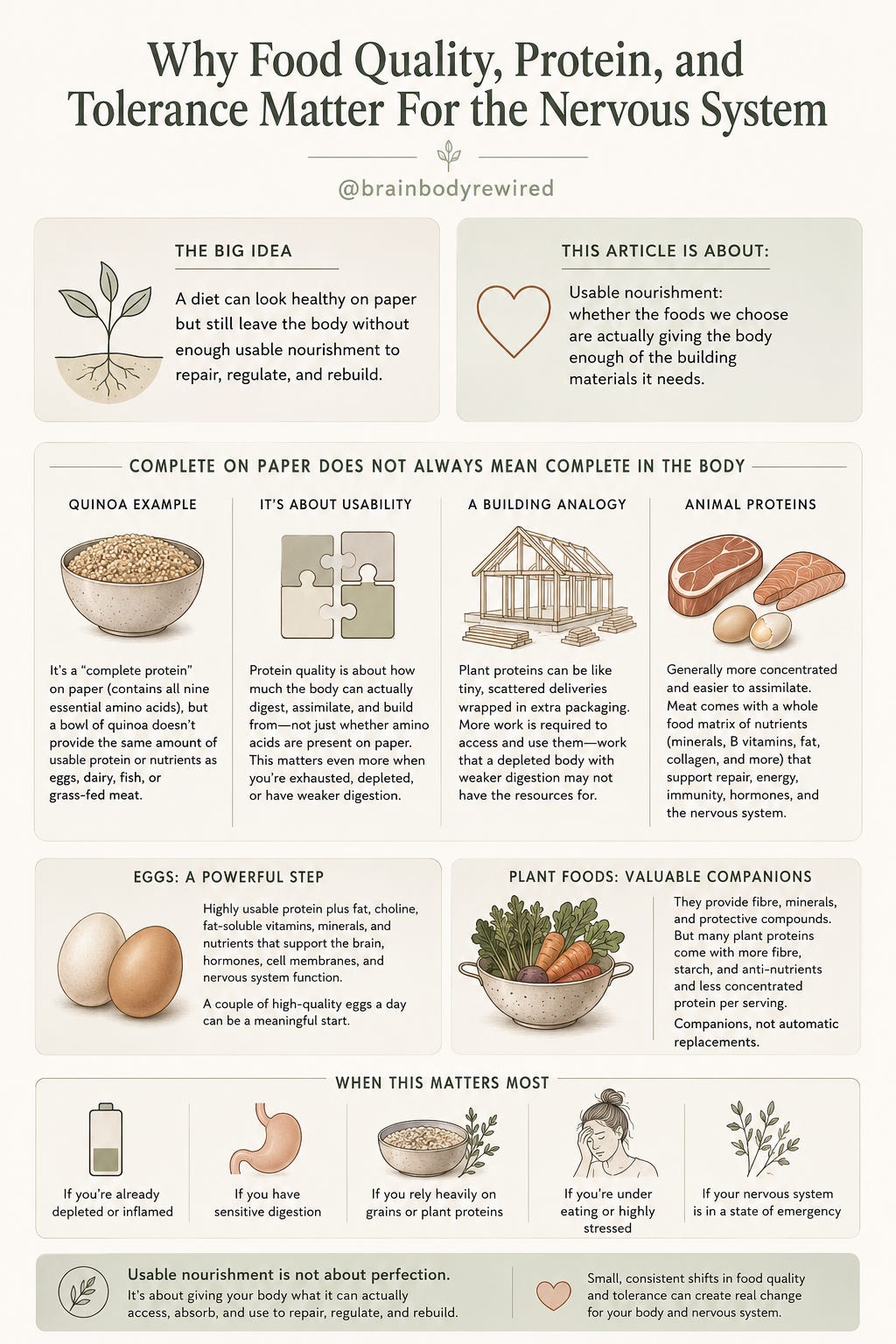
Quinoa is a good example. It is often described as a “complete protein” because it contains all nine essential amino acids, but that does not mean a bowl of quinoa provides the same amount of usable protein, or the same nutrient package, as eggs, dairy, fish, or grass-fed meat.
Protein quality is not only about whether amino acids are present on paper. It is also about how much usable protein the body can actually digest, assimilate, and build from. This matters even more when someone is exhausted, depleted, in a nervous-system state of emergency, or dealing with weaker digestion. In that state, relying heavily on plant-based proteins with lower assimilation, more fibre, more starch, and more anti-nutrients can make an already demanding situation even harder on the body.
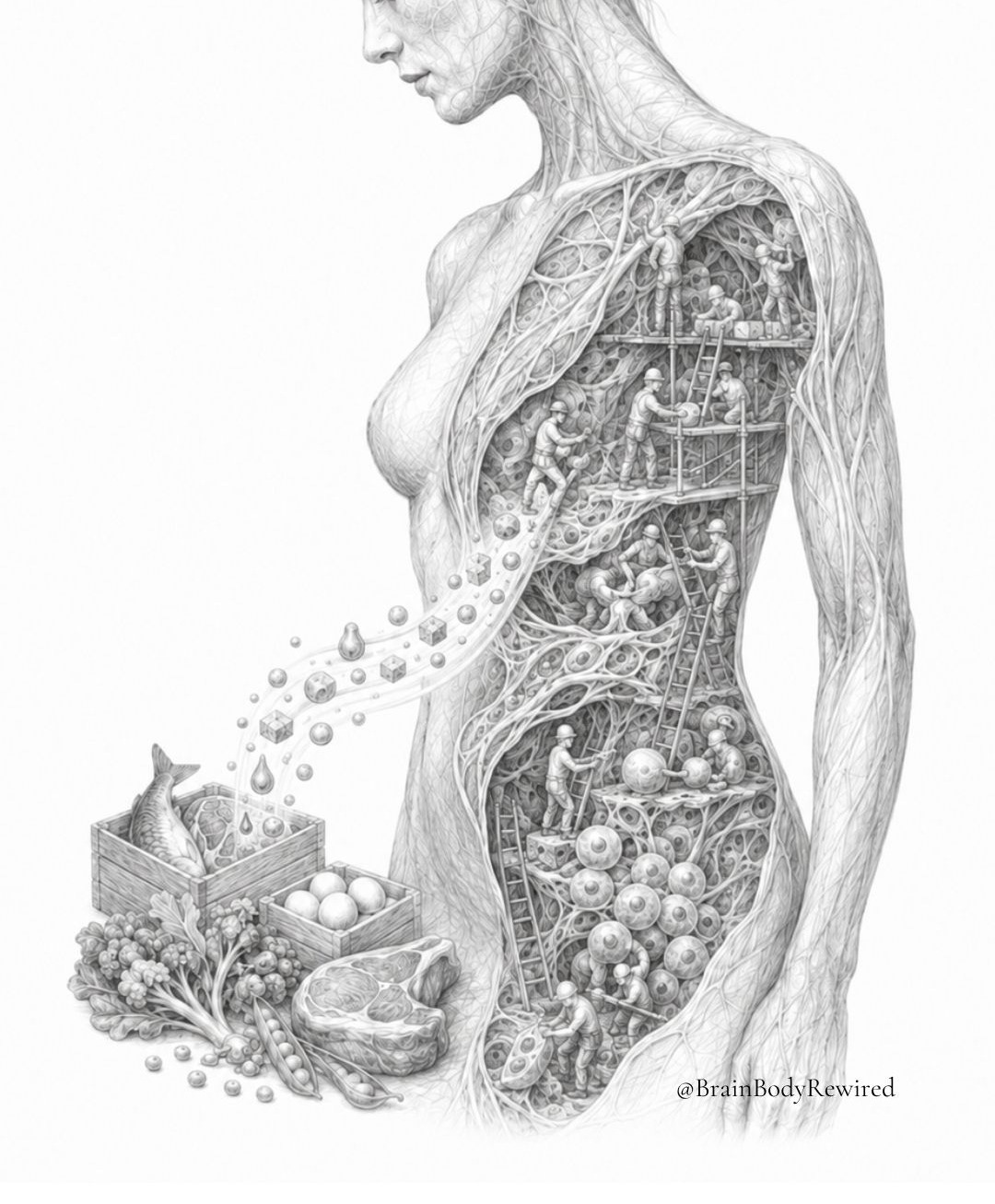
It is a bit like trying to rebuild a house with materials that arrive in tiny, scattered deliveries, wrapped in extra packaging that has to be removed first. The materials may technically be there, but the construction crew has to do much more work to access them, sort them, and use them. For a strong digestive system with plenty of energy, that may be less of an issue. But for a depleted body with weaker digestion and a nervous system already using enormous resources just to stay functional, that extra work can matter.
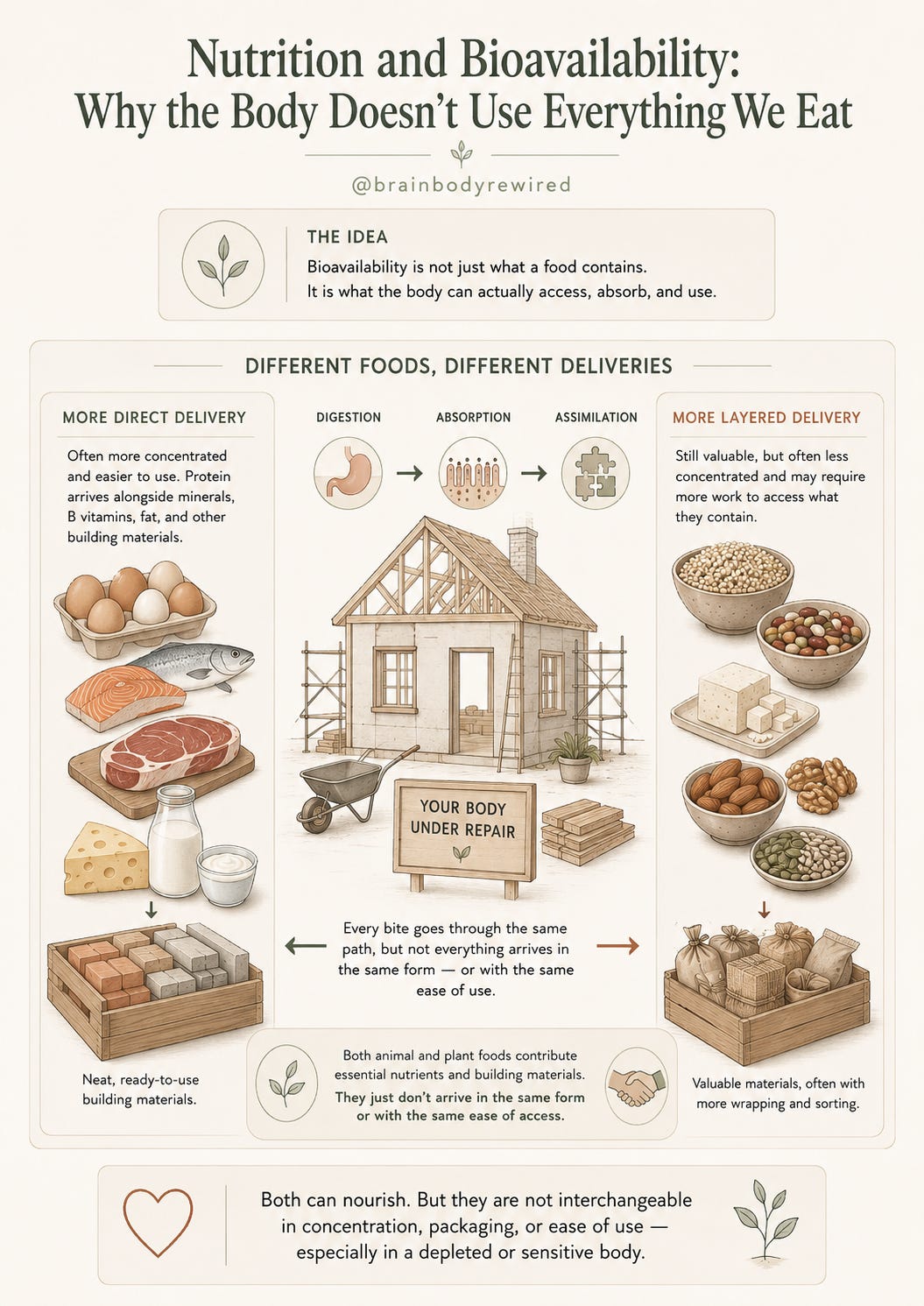
Animal proteins are generally more concentrated and easier for the body to assimilate than most whole plant proteins, while foods like quinoa, tofu, grains, legumes, nuts, and seeds often require more digestive capacity and careful preparation to access what they contain.
Meat is not just “protein.” It comes in a whole food matrix, which simply means the protein arrives alongside other nutrients the body also needs, such as:
minerals like iron and zinc
B vitamins
fat
vitamin K2
collagen or connective tissue, depending on the cut
other compounds that support repair, energy production, immune function, hormones, and the nervous system
This is one reason comparing foods only by grams of protein can be misleading.
Eggs are another beautiful example of this. For people who do not feel ready to eat more meat, even adding a couple of high-quality eggs a day can be a meaningful start. Eggs are often described as one of nature’s most complete packaged foods because they contain highly usable protein along with fat, choline, fat-soluble vitamins, including some vitamin K2, minerals, and nutrients that support the brain, hormones, cell membranes, and nervous system function. For many people, eggs alone may not be enough to bring protein and nutrients up to what the body needs, especially during depletion or rebuilding, but they can still be a powerful step in the right direction.
Plant foods can absolutely contribute valuable nutrients, fibre, minerals, and protective compounds, but many plant proteins come with a different matrix: more fibre, more starch, more anti-nutrients, and often less concentrated protein per serving. That does not make them “bad,” but it does mean they are not always interchangeable with animal foods, especially when someone is depleted, digestively sensitive, or trying to rebuild.
This is not an argument against vegetables or plant foods. I highly recommend eating more vegetables, fruits, herbs, root vegetables, legumes, nuts, and seeds as tolerated because they all have a valuable place in a nourishing diet. But I see them as companions to quality protein and animal foods, not automatic replacements for them. We still need to be honest about the difference between a food containing nutrients and the body being able to access, absorb, and use those nutrients well.
I realize this can be a sensitive topic for some people. My goal here is not to dismiss those choices, but to look honestly at what a depleted body may need physiologically.
This is especially important for people who are already depleted, inflamed, stressed, under-eating, relying heavily on grains or plant proteins, or trying to rebuild after a long period of nervous system strain.
Soy is another place where nuance matters
Soy is often treated as either automatically healthy or automatically harmful, but the more useful conversation is about form, amount, preparation, and context.
Tofu is often treated as a simple protein replacement, but most tofu is not fermented. It is usually made from soy milk that has been coagulated and pressed, which makes it very different from traditional fermented soy foods like tempeh, miso, or natto.
This difference matters, especially when someone is relying heavily on tofu, soy milk, soy isolates, or soy-based meat replacements as a main protein source. In a body dealing with thyroid sensitivity, poor digestion, low mineral status, or nervous system strain, the form, amount, and frequency of soy can matter.
That is the kind of nuance that often gets lost when food is reduced to labels like “plant-based,” “high-protein,” or “healthy,” especially when those labels are applied to soy isolates, soy protein concentrates, or ultra-processed foods built around soy extracts.
Dairy is not one single food
Dairy is another place where nuance matters.
Many people remove “dairy” as if all dairy foods are the same. But commercial cow’s milk, A2 milk, goat milk, sheep milk, water buffalo milk, raw cheese, aged cheese, yogurt, kefir, low-fat dairy, and ultra-processed dairy products can all behave differently in the body.
The animal source, protein structure, fat content, fermentation, processing, and the state of the gut and immune system can all affect tolerance.
For some people, reintroducing dairy may be easier with better-quality, higher-fat, fermented, aged, or non-conventional dairy instead of assuming one reaction to one commercial milk means all dairy is impossible forever.
I’ve seen this in my own home too. My husband has avoided dairy completely for about 40 years. When he was younger, even accidental dairy exposure would usually trigger a migraine and skin reactions. But with a very slow approach rooted in nervous system regulation, he has recently been able to eat small amounts of dairy regularly again by starting with tiny amounts and slowly increasing over time, mainly goat cheese and whole water buffalo milk.
In the last six months, he has eaten more dairy than he had in decades, and he has only had one migraine during that time. That does not mean everyone will respond the same way, but it is a reminder that dairy tolerance is not always fixed, and that the type of dairy, the pace of reintroduction, and the state of the nervous system all matter.
There is also the question of processing. Unhomogenized milk keeps the fat globules closer to their natural structure, while homogenization breaks them into smaller droplets and changes their surface. Some people, myself included, find unhomogenized dairy easier to tolerate, partly because it is usually whole milk with the fat still intact, which can help the body digest and use the nutrients more effectively, especially when digestion, the gut lining, and the immune system are sensitive. This may not apply to everyone, but it is one more example of how processing changes the food the body receives.
Why the whole dairy matrix matters
The body does not receive milk as “calcium plus protein.” It receives a whole food matrix: fat, minerals, vitamins, proteins, microbes when fermented, and signals that work together.
The fat also matters because fat-soluble vitamins, including vitamin D, depend on fat for absorption, and vitamin D works closely with calcium. So when people choose low-fat milk because the label still shows calcium, it can be easy to miss that the body does not use calcium in isolation; it needs the surrounding nutrients and fat-soluble vitamins that help calcium be absorbed, directed, and used properly.
This matters because bone health is not only about how much calcium is listed on a label. The body still has to absorb that calcium, use it properly, and direct it into bones, and that process depends on the whole nutritional context: fat-soluble vitamins like vitamin D and K2, enough protein, minerals like magnesium, hormones, digestion, and the food matrix itself.
This is why someone can drink a lot of low-fat milk and still struggle with low mineral status or bone loss. Removing the fat changes the food, and it may also remove part of what helps the body use the nutrients that dairy naturally provides.
Sometimes the more complete food is easier for the body to understand and assimilate.
A restrictive diet is not always a long-term solution
This is also why dramatic diet changes can be so confusing.
Someone may go vegan, carnivore, gluten-free, dairy-free, keto, or follow another specific diet and feel better quickly, then assume that diet is exactly what their body needs forever. But sometimes the improvement comes less from the label of the diet and more from what was removed or added: fewer ultra-processed foods, less excess sugar, fewer irritating foods, less constant snacking, fewer additives, more vegetables, or simply a pattern that was less overwhelming to digestion and the immune system.
Short-term relief and long-term nourishment are not always the same thing.
A more restrictive diet can sometimes be useful for a season, but it should not become an ideology that keeps someone ignoring their body’s signals. If the body starts showing signs that the diet is no longer supporting energy, digestion, hormones, sleep, mood, strength, or resilience, that matters.
The goal is not to stay loyal to a diet label. The goal is to keep rebuilding a body that can tolerate, digest, and use more nourishment over time.
The body can compensate for a long time
This is one reason diet can be so confusing: the body can compensate for a long time.
If food is not providing enough usable nutrients, the body does not always show obvious signs right away. It can borrow from its own reserves, pull minerals from bones and tissues, break down muscle for amino acids, slow repair, or redirect resources away from less urgent functions so the essentials can keep going.
That compensation can look like “doing fine” for a while, but it has a real physiological cost. When symptoms show up later, they do not always come out of nowhere; sometimes they are the result of a body that has been covering the gap for a long time.
I understand how easy this is to miss. For many years, I ate in a way that is considered healthy and balanced: lots of vegetables, grains, legumes, nuts and seeds, eggs, some dairy, and a small amount of meat. I felt well for a long time, so I had no obvious reason to question it.
But when I eventually had to focus deeply on nervous system regulation, I started noticing how much better I felt when I ate more meat. That led me to increase it very intentionally, especially at breakfast, where I began adding two small sausages made with organic pastured pork, along with eggs and plenty of vegetables.
It was not dramatic or complicated, but it made a noticeable difference because my body was finally receiving more of the building materials it had been asking for. And even then, replenishment was not instant. It has taken a few years of eating this way for my body to feel less fragile around protein intake. Now, about three years later, I can usually have a lighter meat day without feeling it immediately. But if I go two or three days in a row with very little animal protein, I still start noticing familiar signs of weakness, tension, and lower resilience. So I do not approach this as a rigid rule; I simply listen to my body and pay attention to what helps it feel more resourced.
I also want to name that this may be more noticeable in a sensitive nervous system. A sensitive system is not weak, but it often responds faster and more clearly to changes in nourishment, stress, sleep, stimulation, or load. Someone else may not notice the effects of lower animal protein as quickly as I did, but that does not mean the body is not still adapting or compensating in the background.
Food quality changes what the body receives
Food quality matters too.
Grass-fed meat is not just a lifestyle label; what the animal eats changes the food it becomes. Compared with grain-fed beef, grass-fed beef tends to have a different fatty acid profile, including more omega-3 fats, more conjugated linoleic acid, and a more favourable omega-6 to omega-3 ratio.
In simple terms, the animal’s diet changes the food we receive from it. Grain-fed beef and grass-fed beef may both be “beef,” but they are not identical in the body. The fat profile, nutrient balance, and overall quality can shift depending on how the animal was raised and fed. One comes from an animal eating a diet closer to what its body was designed for, while the other often comes from a more industrial feeding system.
In practical terms, that means the body is receiving a different kind of fat and nutrient profile, which can matter for digestion, assimilation, inflammation, and nervous system support.
That does not mean every meal has to be perfect or expensive, but it does mean quality can change what the body receives.
This is also part of why I think we need a bigger conversation about animal foods. Eating meat does not have to mean disconnecting from the animal it came from. When animals are raised well, treated with respect, and more of the animal is used, meat can be part of a nourishing, respectful, and sustainable way of eating.
Histamine, MCAS, and the danger of shrinking the diet forever
Histamine is everywhere in the nervous system space right now, and for good reason.
Histamine reactions can be very real. They can show up as flushing, itching, hives or other skin reactions, and in some people, eczema flares, headaches, congestion, stronger seasonal allergy symptoms, digestive symptoms, sleep disruption, anxiety-like sensations, blood pressure changes, heart racing, or in some people, less commonly discussed patterns like a slower heart rate or other unusual heart-rhythm changes, along with feeling reactive to foods that used to be fine.
For some people, histamine reactions are part of a larger pattern of mast cell activation, where the immune system becomes more reactive to foods, stress, temperature changes, chemicals, hormones, or environmental triggers. This is often discussed under the umbrella of MCAS, or mast cell activation syndrome.
That deserves its own article, but for now, the important point is that food reactivity is not always only about the food. It can also reflect the state of the gut lining, immune system, nervous system, hormones, microbiome, and total body load.
This is also where the gut lining matters. When the intestinal barrier is irritated, the immune system may become more reactive to foods, microbes, histamine, stress, hormones, or environmental triggers. This can overlap with patterns people describe as IBS, skin flares, histamine intolerance, or MCAS-type reactivity.
In that state, the goal is not only to remove more and more foods, but to support the terrain those reactions are happening in: the gut lining, the microbiome, the nervous system, mineral status, protein status, and total body load.
During a reactive phase, reducing histamine often helps some people, and nettle tea can also be a helpful gentle support for a wider range of allergy-like or histamine-type symptoms, including congestion, stronger seasonal allergies, itching, skin reactivity, food reactions, stuffiness, or excess mucus.
These supports can make a reactive phase easier to navigate, and removing reactive foods can be genuinely helpful in the short to medium term. But long-term, the goal is not to keep making the diet smaller and smaller forever.
Some high-histamine foods are also very nourishing foods: sauerkraut, fermented vegetables, aged cheese, bone broth, avocado, vinegar, and fermented dairy. If the body is in a flare or highly reactive state, forcing those foods is not helpful. But once the system has settled enough that a tiny amount can be tested without creating a strong reaction, small amounts may sometimes be more supportive long-term than complete avoidance.
This is not something to force, or to use as a challenge to prove tolerance. It is something to approach slowly, once the body has enough stability to experiment carefully, as part of rebuilding tolerance over time.
A nervous system that feels safer, a gut lining that is less irritated, and a body with better mineral, protein, and nutrient status may be able to tolerate more over time.
The microbiome needs variety, not just restriction
Restriction can sometimes calm symptoms in the short term, but the microbiome also needs variety.
The American Gut Project found that people who reported eating more than 30 different plant types per week had more diverse gut microbiomes than those eating 10 or fewer plant types per week.
That does not mean everyone needs to suddenly eat 30 raw vegetables this week.
And it definitely does not mean “plant-based” processed foods count as the goal.
When I say plant variety, I mean mostly vegetables, along with herbs, fruits, root vegetables, legumes, and smaller amounts of nuts and seeds. These foods provide different fibres, minerals, polyphenols, antioxidants, and compounds that feed different microbes and support a healthy and diversified gut environment.
This matters because the gut microbiome is not separate from the nervous system conversation. It influences digestion, immune signalling, inflammation, neurotransmitter metabolism, gut barrier function, and the messages moving between the gut and brain.
But again, pace matters.
If someone has been eating a very narrow diet with always the same few vegetables, adding variety too quickly can create symptoms. The goal is not to overwhelm the gut with a giant salad and five new fermented foods.
The goal is to gradually expand what the body can handle.
Synergy matters more than macro math
One of the reasons I love real food is that it works in combinations we do not fully understand.
Science has identified many nutrients and many mechanisms, but food is still more complex than isolated nutrients on a label. Protein, minerals, fats, vitamins, microbes, acids, enzymes, fibres, plant compounds, and the food matrix all interact with each other in ways we don’t fully understand yet.
The body understands these combinations.
An apple alone and an apple with cheese and walnuts can feel different in the body. The apple still provides carbohydrates, fluid, fibre, minerals, and plant compounds, but the cheese and walnuts add protein and fat, which slow the snack down and make it more satisfying.
Vegetables with fat, for example steamed vegetables with butter on top, can help the body use fat-soluble nutrients. Meat with vegetables can provide amino acids, minerals, and compounds that support digestion and repair. Slow-cooked meat can bring protein, broth, minerals, fat, warmth, and ease together in one bowl.
This is why I do not want nutrition reduced to “hit your macros.” Macros matter, and protein matters a lot, but the body is not only adding up numbers. It is working with combinations.
Go slowly, but keep moving
With all of this, the most important principle is pacing.
Just because something is good does not mean the body can process a lot of it all at once.
A sensitive body may not need a massive raw salad, six fermented foods, a quart of bone broth, a new supplement stack, organ meats, sourdough, tallow, kefir, sprouted grains, and 30 different plants all in the same week.
For a sensitive body, that kind of intensity can feel less like rebuilding and more like flooding the system. But gradual does not mean stalling either.
Some of this may sound similar to the digestion conversation in Part 2, because the same principle applies here: the body usually rebuilds better through gradual, steady inputs than through sudden intensity.
It means choosing one small change the body can actually integrate, then building from there. That might look like:
a little more protein at breakfast
a cooked vegetable instead of a raw one, cooked enough to soften the fibres but not so much that it becomes mushy and depleted
a slow-cooked meal once a week
a spoonful of sauerkraut instead of a bowl
sprouted bread instead of regular bread
a better-quality dairy option if dairy is being reintroduced
a few extra vegetables across the week
These changes can look small from the outside, but they can become powerful when they are consistent.
And as digestion improves, the effects often start to build on each other.
The body receives more nutrients, the nervous system has more resources, the gut becomes less irritated, appetite becomes clearer, blood sugar feels steadier, and tolerance can expand.
That is the direction we are looking for: not perfection, but building capacity.
Because the goal is not to fear every bite. It is to understand that every bite is an opportunity to support the body’s ability to receive nourishment, use it well, and have enough capacity left to regulate.
So far in this series, we have looked at nutrition from three connected angles. In Part 1, we looked at why the nervous system needs steady nourishment in the first place. In Part 2, we looked at digestion and how food has to be broken down, prepared, and received before the body can use it. And in this article, we looked at usable nourishment: whether the foods we choose are actually giving the body enough of the building materials it needs to repair, regulate, and rebuild.
In the next article, we’ll widen the lens again and look at another layer of nourishment: the quality of the food itself, what it carries, and how that can affect the body and nervous system.
If this way of thinking about food feels helpful, my cookbook-guide Nourishing the Nervous System is a practical next step. It was created to help you bring more steady, usable nourishment into your day through simple meals, flexible recipes, and gentle tips that support a body trying to repair, regulate, and rebuild — without turning food into another source of stress.

Know someone who’s been struggling with symptoms, stress, or a nervous system that feels hard to understand? Send them this. Sometimes understanding begins with something shared by someone they trust.
Subscribe for future articles that make the body make more sense.
References
Herreman, L., Nommensen, P., Pennings, B., & Laus, M. C. (2020). Comprehensive overview of the quality of plant- and animal-sourced proteins based on the digestible indispensable amino acid score. Food Science & Nutrition, 8(10), 5379–5391. https://doi.org/10.1002/fsn3.1809
Mulet-Cabero, A. I., Mackie, A. R., Wilde, P. J., Fenelon, M. A., & Brodkorb, A. (2024). The dairy matrix: Its importance, definition, and current application in the context of nutrition and health. Nutrients, 16(17), 2908. https://doi.org/10.3390/nu16172908
Caffa, I., Proietti, S., Caruso, M., & Longo, V. D. (2025). Nutritional aspects of eggs for a healthy and sustainable consumption: A narrative review. Nutrients, 17(16), 2679. https://doi.org/10.3390/nu17162679
Daley, C. A., Abbott, A., Doyle, P. S., Nader, G. A., & Larson, S. (2010). A review of fatty acid profiles and antioxidant content in grass-fed and grain-fed beef. Nutrition Journal, 9, 10. https://doi.org/10.1186/1475-2891-9-10
McDonald, D., Hyde, E., Debelius, J. W., Morton, J. T., Gonzalez, A., Ackermann, G., Aksenov, A. A., Behsaz, B., Brennan, C., Chen, Y., DeRight Goldasich, L., Dorrestein, P. C., Dunn, R. R., Fahimipour, A. K., Gaffney, J., Gilbert, J. A., Gogul, G., Green, J. L., Hugenholtz, P., … Knight, R. (2018). American Gut: An open platform for citizen science microbiome research. mSystems, 3(3), e00031-18. https://doi.org/10.1128/mSystems.00031-18
Smolinska, S., Jutel, M., Crameri, R., & O’Mahony, L. (2022). Histamine: A mediator of intestinal disorders—A review. Metabolites, 12(10), 895. https://doi.org/10.3390/metabo12100895
The distinction between a diet that looks complete on paper and one that actually nourishes the body is one of the most important conversations being had right now.
But the part that stopped me completely was compensation. The body covering the gap so well that depletion becomes the baseline.
I have seen this in women around me for years and never had the language for it until this series.
What you are building here is something I keep coming back to.
So much wonderful information in this newest article, Gabrielle. Your series on Substack BrainBodyRewired is truly remarkable. Ps I love your e-cookbook with so many practical recipes which illustrate how easy it can be to make steady improvements to your diet. Bravo yet again!