

New here? Start here!
A gentle guide to finding your way on Brain Body Rewired, where to begin reading, and how to find the right next step for your nervous system.

Welcome! I’m glad you’re here.
Brain Body Rewired is a place for understanding the body through a physiology-first lens: nervous system dysregulation, symptoms, sensitivity, protection mode, capacity, rest, nutrition, and the slow work of rebuilding regulation.
Since so many new readers have joined Brain Body Rewired in recent months, I wanted to create a clearer way into the growing archive, while also giving those who have been here for a while an easier way to revisit the threads most relevant to them.
There are articles on the autonomic nervous system, the vagus nerve, stress, fascia, muscles, digestion, nutrition, rest, hormones, mitochondria, sensitivity, symptom patterns, and the body’s protective responses.
You do not need to read everything at once.
Each article is written to stand on its own, but there is also a larger arc to the work. For readers who like to follow that progression from the beginning, the archive tab is the best place to read the articles in order.
This page is here to give you a clearer starting point.
If your body feels confusing, reactive, sensitive, exhausted, or difficult to trust, begin with the pieces that feel most relevant to where you are right now. You can always come back and follow the next thread later.
A good place to begin
If you are trying to understand what nervous system dysregulation actually is, start here:

This is the clearest reference article for understanding what I mean when I talk about nervous system dysregulation.
It explains why the body can start reacting to life differently, why symptoms can move through many systems, and why dysregulation is not only about feeling stressed or anxious.
Start here if you are wondering:
Why does my body feel more reactive than it used to?
Why do symptoms seem connected, even when they look unrelated?
Why can ordinary life suddenly feel like too much?
To understand the autonomic nervous system
This is one of the most important foundations of my work.

The vagus nerve matters, but the autonomic nervous system is bigger than the vagus nerve alone. This article explains the sympathetic nervous system, parasympathetic pathways, and the gut’s own nervous system, and why dysregulation can affect the heart, digestion, breathing, sleep, temperature, energy, and more.
Read this if you want to understand why nervous system work is not only about calming down.
It is about the whole body.
To understand protection mode
This article explains why the body may begin prioritizing survival over repair, digestion, sleep, hormone balance, and long-term healing.

When the nervous system senses too much pressure for too long, it can shift into protection mode. That shift can feel frightening, frustrating, and confusing, but it is not random.
Read this if you feel like your body is stuck on alert, shut down, or unable to return to normal life as easily as it used to.
To understand why stress becomes physical
This is one of the most-read articles on Brain Body Rewired, and I think that makes sense.

Many people can feel that stress is not only in their thoughts. It is in the body. In the jaw. The shoulders. The chest. The gut. The fascia. The muscles. The way the body braces, protects, holds, and remembers.
This article explores how stress, tension, trauma, and recurring physical patterns can be connected to the nervous system, and why the body may need more than mindset work to unwind.
To understand sensitivity and reactivity
If your body reacts strongly to foods, supplements, light, sound, stress, emotions, screens, sleep disruption, or small changes in routine, this is a good article to read.

A sensitive nervous system is not weak.
It is often a system that is processing more intensely, reaching overload more easily, and needing different conditions to stabilize.
This article explains why sensitivity can increase when capacity is low, and why the goal is not to shame the body for reacting, but to understand what it may be responding to.
To understand repeated symptom patterns
This article introduces one of the ideas that has become very important in my work: the body’s signature pathway.

Sometimes symptoms do not appear in completely random ways. The body may return to familiar routes, familiar systems, or familiar sensations when it is under strain.
This does not mean the symptoms are imagined. It means the nervous system and body can learn patterns.
Read this if you notice that your symptoms tend to show up in the same places, follow similar sequences, or return during certain kinds of stress, depletion, or overload.
To understand the nutrition layer
Nervous system recovery is not only about tools, breathing, mindset, or vagus nerve exercises.
The body also needs nourishment.

This article explains why undernourishment can keep the body in stress, why real food matters for regulation, and why the nervous system needs building blocks to repair, stabilize, and rebuild capacity.
This is also the first article in my nutrition series, which eventually led to my cookbook-guide, Nourishing the Nervous System (more details below).
If rest is your biggest struggle
If you are resting but not recovering, this article may help.

Rest is not always simple when the nervous system has been under strain for a long time. Stillness can feel unfamiliar. Quiet can feel exposed. Sleep can feel difficult. Doing nothing does not always mean the body feels safe enough to restore.
This article explains different kinds of rest, why rest can feel hard, and why the body may need reduced input, rhythm, nourishment, and safety before rest becomes truly restorative again.
If you want to know more of my story
This is the most personal piece I have shared here so far.
It tells part of my own story: what happened when my nervous system reached its limit, how my body changed almost overnight, what recovery taught me, and why Brain Body Rewired exists.

I waited a long time to share this story, because I did not want to write from the middle of it. I wanted the distance, hindsight, and understanding to tell the larger arc honestly.
If you have ever wondered why I care so deeply about this work, this is the piece to read.
If you want a structured first step
If you recognize yourself in this work but still feel unsure where to begin, I created my first short program as a gentle starting point.
Understanding Your Nervous System: The First Layer of Recovery
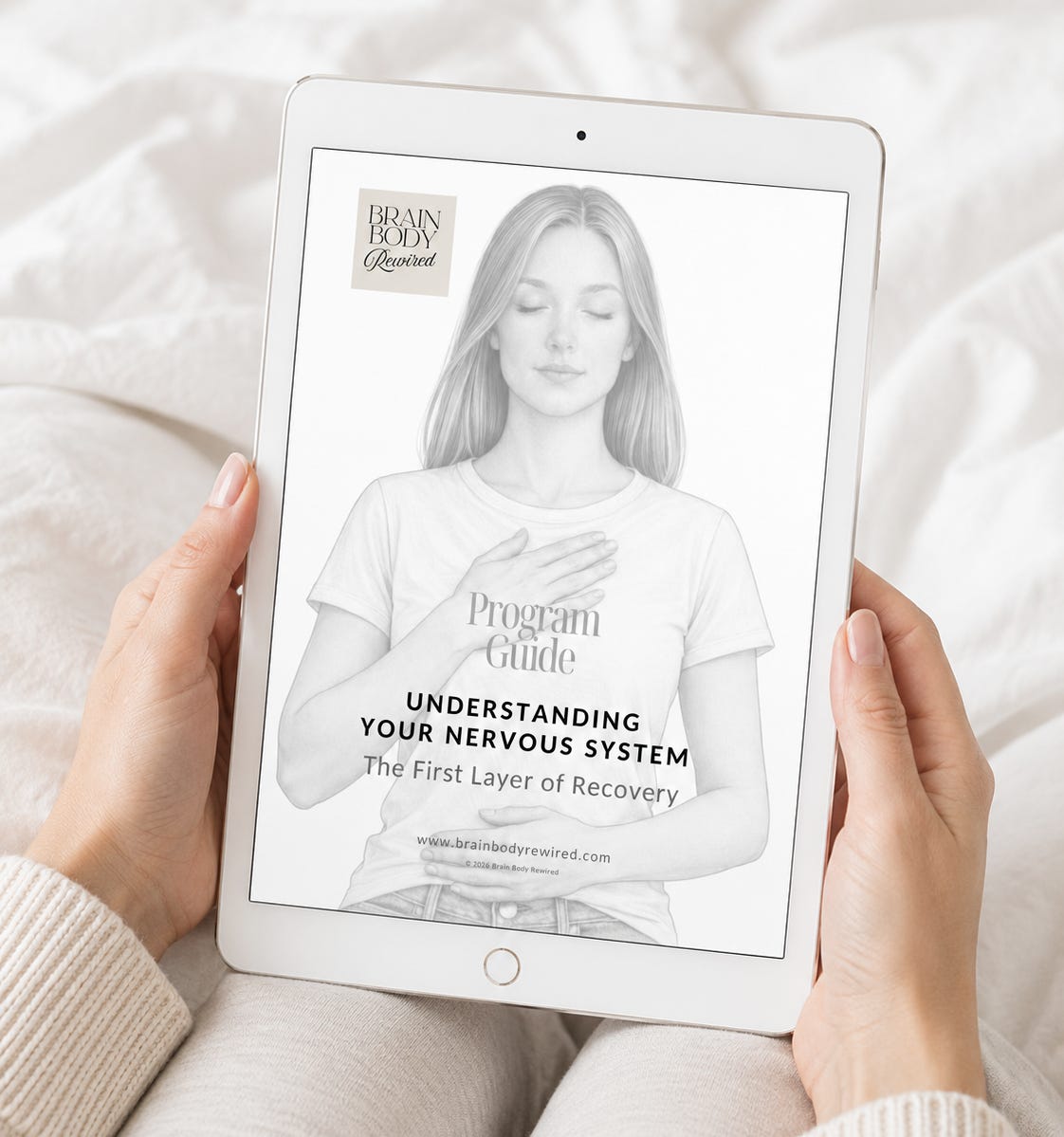
This is a short, physiology-first program for people who want to understand their nervous system patterns, begin interrupting escalation, reduce overall load, and start stabilizing without overwhelming the body.
It includes:
5 short video lessons with slides and voice-over
A 60-page companion PDF guide
Reflection pages to help you notice your own patterns
Simple tools for early nervous system stabilization
Guidance for interrupting escalation and reducing load
A low-capacity friendly structure you can move through slowly
Lifetime access
The first layer of my framework is understanding and interruption.
Not forcing calm.
Not adding a giant protocol.
Not doing more just for the sake of doing more.
But beginning to understand what your body may be doing, interrupting the early escalation loop gently, lowering the load on your system, and creating enough stability for the next layers of recovery to build from.
Introductory Founding price: US$67 until Friday, August 7th, 2026
Regular price after August 7th: US$97
If you want practical food support
I also created Nourishing the Nervous System, a practical cookbook-guide for supporting the body with simple, nourishing meals when capacity is low.
It includes flexible recipes alongside practical tips and guidance for supporting your nervous system through food, with low-capacity strategies to make nourishment feel more manageable.
This guide was created to make nourishment feel simpler and more doable, especially when your body is already dealing with a lot.
Price: US$19

A gentle way to use this work
You don’t need to read everything at once or figure it all out today.
Start with what feels most relevant, and let yourself move slowly from there.
Notice what helps you understand your body with a little less fear, and come back when you have more capacity.
This work isn’t about forcing calm.
It is about understanding the patterns, reducing the load, supporting the body, and rebuilding capacity one layer at a time.

Know someone who’s been struggling with symptoms, stress, or a nervous system that feels hard to understand? Send them this. Sometimes understanding begins with something shared by someone they trust.
Subscribe for future articles that make the body make more sense.
The content shared here is for educational purposes only, reflects research and lived experience, and is not intended to replace individualized medical advice or care.
Saved so I can come back 😊
Gabrielle, this is exactly what an entry point should do, it removes the overwhelm of an archive without flattening the depth of what's actually there.
Most indexes organize by topic. Yours organizes by what someone might actually be feeling when they arrive, which asks so much less of a reader who's already at capacity.
That's not just good structure. It's good care, applied to structure. ✨